Most people reach for a bottle of drain cleaner first. Plumbers tell you not to, mostly because of the pipe in your house and what is blocking it. Below is why, and what to do instead in a Fergus house.
Drain cleaner rarely reaches the blockage that matters
Chemical drain cleaners can work on hair and soap close to the drain opening. Most blockages that need a plumber are further down the line. In a kitchen it is usually grease that has set hard in the branch line. Under an older house it is often roots in the clay sewer pipe between the house and the street. The chemical sits in the standing water above the blockage and does very little to either.
If it doesn't clear the drain, you are left with a sink or tub full of chemical-laden water. Anyone who plunges it, opens the trap or runs a cable through it can get that water on their hands, arms or face. If you have already poured something in, tell the plumber what it was and when you poured it.
It is hard on the pipe in older Fergus houses
The pipe under your sink depends on when the house was built, and the older types handle chemicals worst.
- Stone houses on St. Andrew Street, St. Andrew Street West and Union Street West, built between 1857 and 1908. Houses of this age typically have cast iron stacks, galvanized steel pipe and a clay tile sewer lateral. Old cast iron and galvanized pipe is already corroded on the inside. Harsh chemicals left sitting in it, especially acid-based ones, eat further into the pipe wall and the weak joints.
- Victory homes around Webster Park, built between 1948 and 1954. On Churchill Crescent, Edinburgh Avenue, Forfar Street and James Street, the drains are usually cast iron and the lateral is clay. Worn cast iron is rough inside, and that roughness catches grease and paper. A chemical won't make it smooth again.
- Storybrook and other new builds from the late 2010s on. These houses have PVC or ABS drains, which stand up better. But many drain cleaners heat up as they react, and repeated hot doses into a trap full of standing water are hard on plastic joints.
Roots and hard-water deposits do not dissolve
No household drain cleaner will clear roots from a clay lateral. Roots get in at the joints, and even when part of the mass breaks off, the rest stays and grows back. The fix is to cut them out with a cable and then look at the pipe with a camera.
Fergus water is very hard. The Township reports an average hardness of 540 mg/L as calcium carbonate, which is 38 grains, and notes that the minerals cause scale buildup in pipes and appliances. In tub and shower drains, those minerals combine with soap and hair into a firm deposit. Chemicals take a long time on it, and the deposit usually has to be removed mechanically. Many Fergus homes run a water softener, which reduces how much new scale forms.
Never mix products
Don't pour a second drain cleaner on top of the first, and never follow one with bleach or another cleaner. Some combinations give off dangerous gas or react violently in the pipe. Don't plunge a drain that has chemical in it, because the plunger splashes it straight back at you.
How to unclog a drain quickly yourself
Start by checking whether the problem is one fixture or several.
- One slow sink, tub or toilet: that is usually a local blockage you can try to clear yourself.
- Several fixtures slow at once, or the basement floor drain backing up: that points to the main line. Stop running water in the house and call a plumber. A plunger or a bottle won't fix it.
For a single fixture, work through these in order:
1. Plunge it properly. Use a cup plunger on sinks and tubs and a flange plunger on toilets. Block the overflow hole with a wet cloth. On a double kitchen sink, plug the other side. Use firm, steady strokes with enough water to cover the cup.
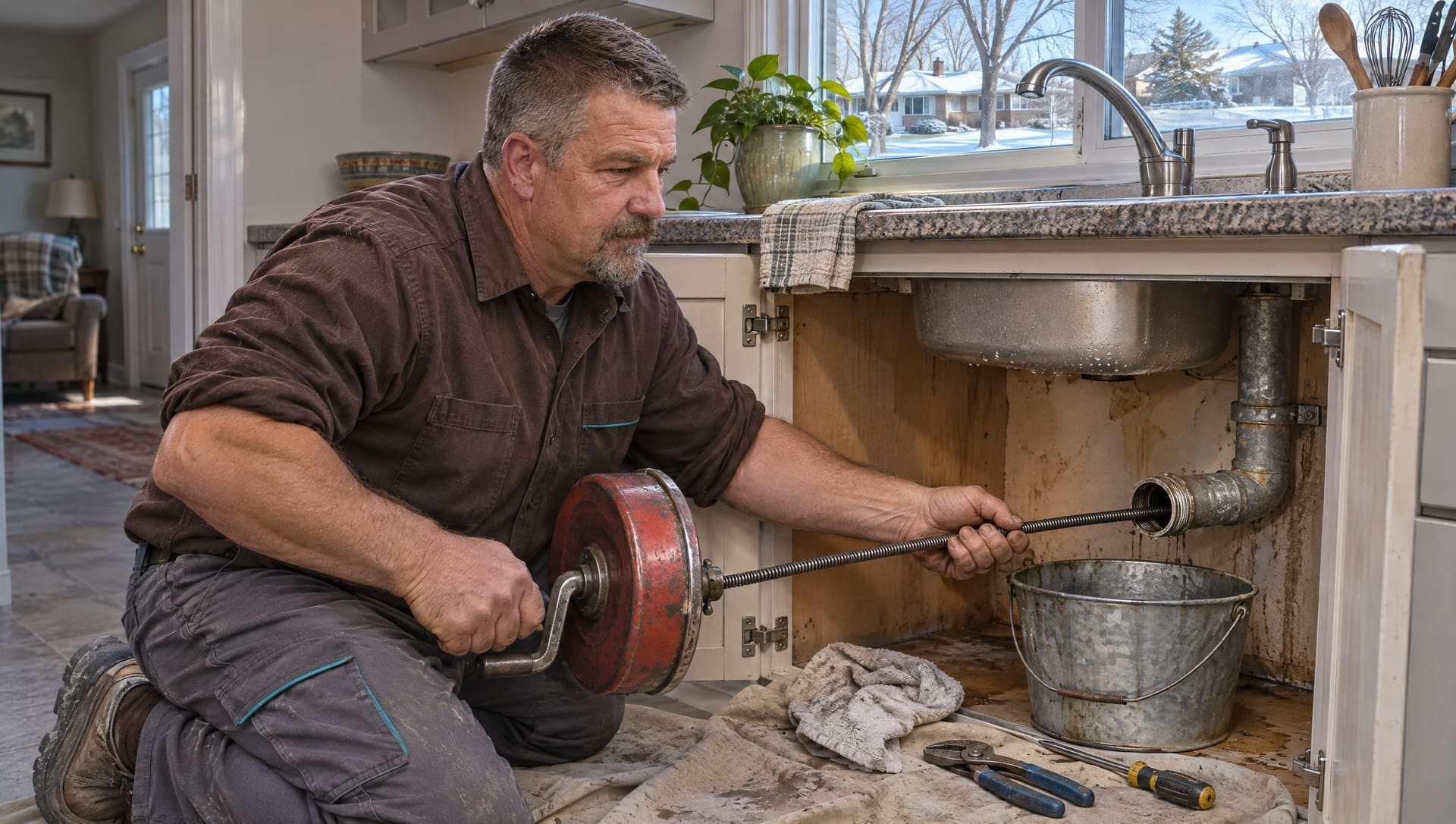
2. Clean the trap. Put a bucket under the sink and undo the two slip nuts on a plastic trap by hand. Empty it, rinse it and check the pipe going into the wall.
3. Pull out hair. In bathroom sinks and tubs, a plastic barbed drain strip or a small hand auger brings up most hair clogs. Lift out the pop-up stopper first.
4. Use hot tap water on a kitchen sink. Hot water from the tap can soften fresh grease. Don't pour boiling water into plastic traps or toilet bowls.
If none of that works, stop there. Pushing harder with a rented machine on old cast iron or clay pipe can make a small problem bigger.
What plumbers recommend to keep drains clear
Prevention takes less effort than clearing a blockage, and none of it needs a product.
- Keep grease out of the sink. Let fat and oil cool in a container and put it in the garbage. Scrape plates into the garbage or compost before rinsing them.
- Don't count on a garbage grinder. The Township prohibits garbage grinders, so food waste shouldn't go down the kitchen drain at all.
- Use strainers. A hair catcher in every tub, shower and bathroom sink stops most bathroom clogs before they start.
- Flush only toilet paper. Wipes sold as flushable don't break down like paper. They catch on rough cast iron and on roots in a clay lateral.
- Use enzyme products for maintenance only. If you want to use something regularly, enzyme drain products are gentler on pipe. They work slowly, though, and they won't clear an existing blockage.
How plumbers clean drains
A plumber starts by asking which fixtures are slow and since when. Then they find the nearest cleanout and choose a method to suit both the blockage and the pipe:
- A cable machine with a cutting head sized to the pipe, for paper, hair, grease plugs and roots.
- High-pressure water jetting where the pipe can take it, to scour grease and scale off the pipe wall.
- A camera, run down the main line after it is cleared, for a recurring blockage or a suspected root problem in a clay lateral. You see what is in the pipe before you decide whether cleaning will hold or a section needs repair.
Work is performed by licensed plumbers (306A Certificate of Qualification).
Who owns which part of the sewer pipe
In Fergus, the Township collects sanitary sewage and treats it at a treatment plant. The owner is financially responsible for the water and sewer service pipes in the ground on their side. If a plumber finds that the blockage is in the Township's sewer main on the street, they should not try to clear it. The Township deals with that part.
When the problem is a broken or collapsed section on your side, the job changes from cleaning to sewer repair. Changes to drains generally need a building permit, and the Township's building department can tell you whether your job does. Clearing a line is usually a much smaller job than repairing one, which is another reason not to risk the pipe with chemicals.
What is the best drain cleaner in Canada?
A good plunger and a hand auger. No bottle on any shelf will clear roots, a set grease plug or a cracked clay pipe. If a drain keeps blocking every few months, switching brands won't help, because the problem is the pipe or what goes into it. That is when a plumber should look at the line. For more common questions, see the FAQ.
If a drain in your house keeps coming back slow, see drain cleaning from Fergus Plumbing and Drain.