The Township of Centre Wellington supplies Fergus with groundwater from municipal wells. It reports an average hardness in Fergus of 540 mg/L as calcium carbonate, which is 38 grains. The Township says these minerals cause scale in pipes and appliances, and that many homes use water softeners.
Heating water makes scale form faster, so the water heater is where hard water does the most damage. Most of the advice below follows from that.
Scale is what wears out a water heater here
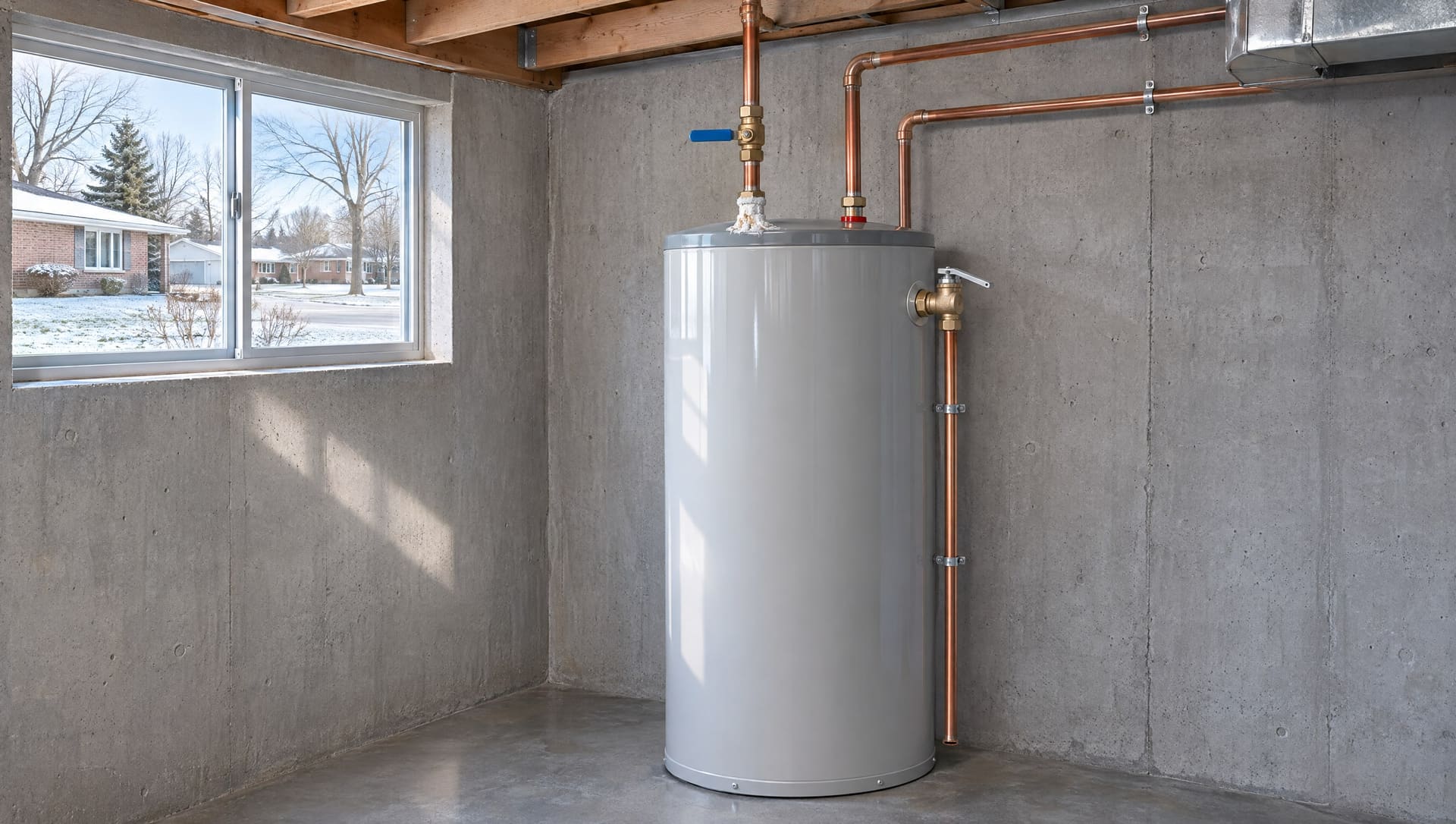
In a tank heater, the minerals settle on the bottom as a crust. On a gas tank, the crust sits between the burner and the water. The burner has to run longer, and the tank rumbles or pops as it heats. In an electric tank, scale builds up on the elements until they burn out. In a tankless unit, scale lines the narrow passages of the heat exchanger. Flow drops, and the unit shuts down with an error code.
Signs that scale is the problem:
- Popping, rumbling or crackling while the tank heats
- Hot water runs out sooner than it used to
- White or tan grit in the aerators and showerheads
- An electric tank that keeps burning out elements
- A tankless unit that reports a fault or gives lukewarm water at high flow
What plumbers recommend for 38-grain water
No one brand is right for every house. The heater has to suit the water and be looked after. In Fergus that means:
- Treat the water first. A softener on the line that feeds the water heater does more for its lifespan than anything else. If you already have one, check that it is working and has salt. A softener with an empty brine tank does nothing.
- Flush the tank every year. Turn off the power or set the gas to pilot, run a hose from the drain valve to the floor drain, and drain until the water comes out clear. In unsoftened Fergus water, the first bucket is often full of sediment. If the drain valve will not open or will not close again, stop and call a plumber.
- Check the anode rod. The anode is a metal rod inside the tank that corrodes so the tank does not. Softened water can wear it down faster. A plumber can pull it, look at it and replace it before the tank starts to rust.
- Descale a tankless unit on a schedule. Tankless heaters need their heat exchangers flushed with a descaling solution. With water this hard and no softener, that job comes round often. Ask how often your unit needs it before you buy one.
- Size it to the household. A tank that is too small runs flat out all the time and builds scale faster. One that is too big heats water you never use. Count bathrooms, people and anything that draws a lot of hot water, such as a large tub.
Read the manufacturer's warranty before you buy. Some ask for proof of maintenance or set conditions on water quality. Keep a note of each flush and each anode check.
Your house affects the choice
The stone houses on St. Andrew Street and Union Street West, built between 1857 and 1908, often still have galvanized steel supply pipe. That pipe narrows with corrosion and scale. A new water heater will not fix low hot-water pressure if the pipe feeding it is half closed. These basements usually drain only through a floor drain. Keep that drain clear, because it is where a leaking tank's water has to go.
The Victory homes around Webster Park on Churchill Crescent and Edinburgh Avenue, built between 1948 and 1954, often had no basement at first. If the heater sits in a crawl space or a basement added later, check that its supply lines are not exposed to the cold. Fergus sees freezing or colder temperatures on about 30 days each January.
Storybrook and the other newer homes have PEX supply lines and plastic drains, so the piping itself is rarely the problem. The usual calls are scale in water heaters, softeners and fixtures. A new house with no softener is running the full 38 grains through its water heater.
Safe temperatures
Ontario's Building Code (Part 7, Article 7.2.10.7) limits water coming out of a shower head or into a bathtub to 49 °C. The tank is often set hotter than that, and a mixing valve brings the water down to a safe temperature at the tap. If your taps scald, or you have small children or older people in the house, ask a plumber to check the tank setting and any mixing valve. Turning the tank down also slows scale a little, because cooler water drops fewer minerals.
Am I allowed to install my own water heater?
Gas water heaters: no. Under Ontario Regulation 212/01 (Gaseous Fuels), a gas-fired water heater must be installed and serviced by a contractor registered for gas work, using qualified gas technicians. That covers the gas line, the venting and setting it up. Gas work is performed by TSSA-certified gas technicians.
Electric water heaters and the plumbing side: in Ontario, plumbing is a compulsory trade. Anyone doing it as a trade must hold a Certificate of Qualification or a provisional one, or be a registered apprentice, and appear on the Skilled Trades Ontario Public Register. Separately, under the Building Code Act, 1992, installing or materially changing plumbing generally needs a building permit. The Township of Centre Wellington's building department decides whether a particular job does. Call them before you start a job yourself, not after.
Also check whether you own the tank. Many Ontario homes rent their water heater. A rented tank belongs to the rental company, and you may have to return it or buy it out when you replace it. Your bill or the sticker on the tank will tell you which applies.
How much does it cost to replace a water heater in Ontario?
This guide does not give figures, because the answer depends on the house. These are the things that move the price:
- Fuel and venting. Swapping a gas tank for the same type with the same venting is the simplest job. Changing the venting, or switching between gas and electric, adds work.
- Size and type. Bigger tanks and high-efficiency models cost more to buy and sometimes to install.
- The pipe around it. Old galvanized connections, a shut-off valve that has seized, or missing safety parts such as an expansion tank add to the job.
- Getting it in and out. Narrow stairs, a tight crawl space or a closet install all take longer.
- Permit and disposal. If a permit is needed, that is part of the cost, and so is taking the old tank away.
- Water treatment. Adding or repairing a softener is a separate cost, but in Fergus it protects whatever you install.
Ask for a written price that lists each of these, so you can compare quotes on the same terms.
Do tankless water heaters cost more?
Usually yes, at the start. The unit costs more than a standard tank. A gas tankless often needs a larger gas line and new venting, and an electric one may need a bigger electrical service. Over time they use less energy because they do not keep a tank of water hot.
In Fergus, hard water changes the sums. Without a softener, a tankless unit needs descaling regularly, and every visit adds to the running cost. If you are considering one, budget for water treatment and regular descaling, and decide whether the energy savings still come out ahead for your household.
Fergus Plumbing and Drain can test your tank, flush it, check the anode and give you a written price for a repair or a replacement. Work is performed by licensed plumbers (306A Certificate of Qualification). For the softener-side questions, see our water heater service.