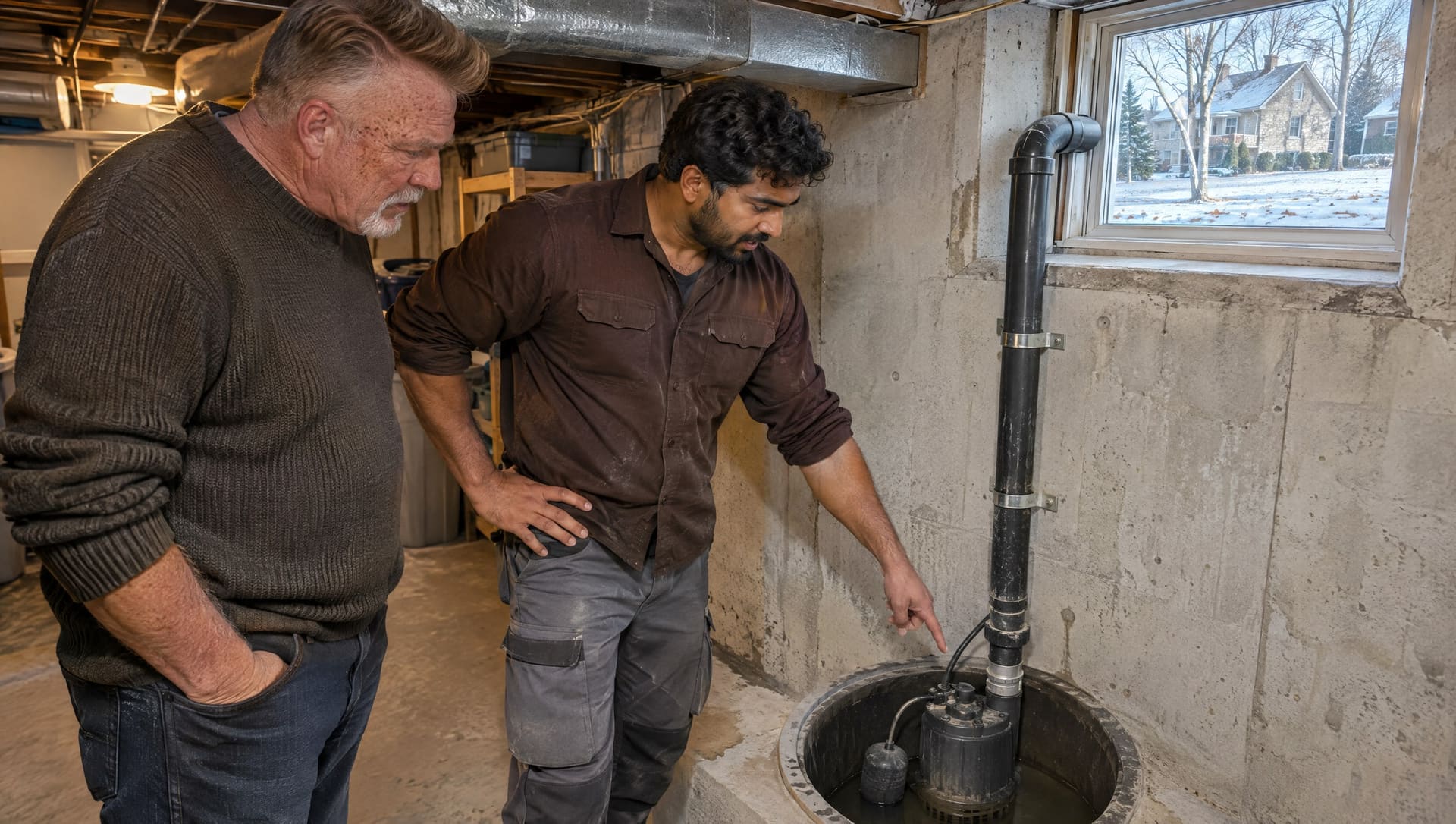
Lift the lid on the sump pit in a Storybrook basement and you will see a pipe coming in through the side. That is the weeping tile around the foundation. The pump in the pit is the only thing that gets that water out of the house. When the pump stops, the pit fills and water comes up through the basement floor.
Houses built in Fergus from the late 2010s onward are built this way. In most of them, the pump in the pit is the one that came with the house.
No pump has a fixed lifespan
There is no single number of years to plan around. What wears a pump out is how often it runs and the conditions it runs in. These are the main factors:
- How wet the lot is. A pump on a low lot with a high water table may run through most of the spring. One on a dry lot may sit idle for months.
- The float switch. It often fails before the motor does. It can stick on the side of the pit or get caught on the power cord.
- What is in the pit. Silt, gravel and construction debris get pulled into the intake and wear the impeller.
- Short cycling. When the check valve fails, water falls back into the pit and the pump starts again on the same water.
- Sitting idle. A pump that never runs can seize, so a dry pit does not mean the pump is fine.
Fergus weather decides when a pump does most of its work. The 1981 to 2010 normals for the Fergus Shand Dam station give about 946 mm of precipitation a year: about 798 mm of rain and 148 cm of snow. On about 5 days a year, 25 mm or more of rain falls. Snow lies on the ground on about 106 days, and all of it melts into the soil around your foundation in spring. A pump that is close to failing usually stops during a downpour or the spring melt, because that is when it runs hardest.
Signs a pump is near the end
- It runs when there has been no rain or melt, or it switches on and off every few seconds.
- It hums but no water moves.
- It grinds, rattles or vibrates louder than it used to.
- The water in the pit rises higher than usual before the pump starts.
- The breaker trips, or the pump only works after you jiggle the float.
- There is rust or a crust of scale on the housing and the discharge pipe.
If you see one of these, replace the pump before spring rather than waiting for the next storm.
Test it twice a year
Do this in early spring before the melt and again in the fall:
- Pour a pail of water slowly into the pit until the float rises.
- The pump should start, empty the pit and shut off cleanly.
- Go outside and check that water is coming out at the end of the discharge line.
- Watch the pit for a minute. If the water level rises again with no new water coming in, the check valve is letting water back down.
- Unplug the pump before you reach into the pit to clear debris or free the float.
Battery backup is for the night the power goes out
Heavy rain and power outages tend to arrive in the same storm. A battery backup pump sits in the same pit with its own float, set a little higher than the main pump's. It runs if the power is out or the main pump fails. Most come with an alarm. The battery has to be checked and eventually replaced, so test the backup along with the main pump.
A plain high-water alarm is the simplest addition if you have nothing else. It will not move water, but it will wake you while there is still time to act. If water is already over the floor, see our emergency plumber page.
Where the water is allowed to go
Fergus has two separate sewer systems, and sump water belongs in only one of them.
- The sanitary sewer collects waste from sinks, showers and toilets and carries it to a treatment plant.
- The storm system carries road runoff and sump pump discharge from homes straight to the Grand River.
So sump water should never go into the sanitary side. Do not run the discharge hose into the laundry tub, the floor drain or a sewer cleanout. That puts clean groundwater into pipes that are sized for wastewater. During heavy rain, that extra water can help push sewage back up into basements along the street.
Can I drain my sump pump into my yard?
On many lots the discharge runs out through the wall and onto the lawn. The Township already asks owners to direct eavestrough downspouts onto their own property. Your lot may be set up for discharge onto the ground or for a storm connection, depending on how it was built. The Township can tell you which applies at your address.
If the water goes onto the yard, follow these rules:
- Send it well away from the foundation. If it soaks back in beside the wall, it returns through the weeping tile and the pump runs the same water again.
- Discharge onto ground that slopes away from the house.
- Keep it off your neighbour's lot, and off the driveway or sidewalk, where it will freeze.
- Never discharge into a window well.
Winter is when discharge lines cause trouble. At the Fergus Shand Dam station, the January mean daily minimum is -11.1 °C. The temperature falls to freezing or below on about 30 January days and below -10 °C on about 16 of them. A hose lying on the surface, or a buried line that holds water, can freeze solid. Then the pump pushes against a blocked pipe. To prevent it:
- Slope the line so it drains completely between cycles.
- Take off any long extension hose for the winter.
- Keep the outlet clear of snowbanks.
- Ask about a freeze-relief fitting near the house, so water can still escape if the line further out freezes.
Older Fergus houses are a different case
The stone houses on St. Andrew Street were built between 1857 and 1908. Houses of that age usually have only a floor drain in a stone-walled basement, with no sump pump. The Victory homes on Churchill Crescent and Edinburgh Avenue were built between 1948 and 1954. Many were set on concrete blocks with no basement, and some had a basement added later. In those houses, water in the basement may be groundwater, or it may be sewage coming back up the floor drain, and each needs a different fix.
Adding a sump pit and pump is new work on drains. New plumbing and changes to drains generally need a building permit, and the Township's building department can tell you whether your job does. If the problem is sewage backing up through the floor drain, a backwater valve is the more likely answer. See sewer repair and backwater valves.
What replacing a sump pump motor involves
On most household submersible pumps, the motor is sealed inside the pump housing. It is not repaired separately, so "replacing the motor" means replacing the pump. On a pedestal pump the motor sits on a column above the pit, and it can sometimes be replaced alone.
We don't publish figures here, because the cost depends on what the job includes:
- The type and capacity of the pump, matched to how much water your pit actually takes in.
- Whether the check valve and discharge pipe can be reused. Replacing an old check valve with the pump is often sensible.
- The condition of the pit and its liner.
- Whether you add a battery backup or a high-water alarm at the same time.
- How easy the pit is to reach. A finished basement may have a pit boxed in behind a panel.
Ask for a written, itemized price so you can see which parts of the job are optional. Check the manufacturer's warranty on your current pump too. It runs from the purchase date, and some failures are covered.
If your pump is humming, cycling or due for its spring test, see our sump pump service.